
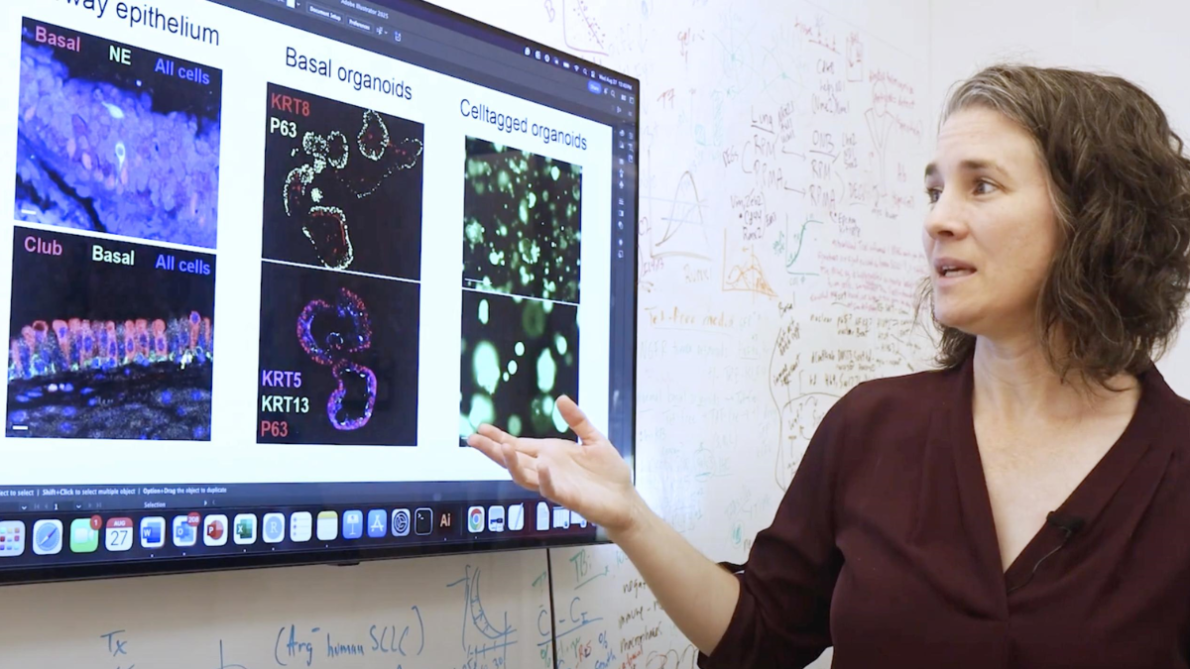
The lab of Trudy G. Oliver, PhD, a professor of pharmacology and cancer biology at Duke University School of Medicine, focuses on cancer cell identity and lineage plasticity —understanding how developmental programs govern cell state, differentiation, and therapeutic vulnerabilities in cancer. Last year, her team made a discovery that marked a major shift in understanding of the origins of small cell lung cancer.
She traces that scientific perspective — thinking about cancer through a developmental lens — directly to her doctoral training in pharmacology and cancer biology at Duke. “As a graduate student at Duke, I was immersed in the study of developmental signaling pathways like Hedgehog, Wnt, Notch, and TGF-β, and their roles in cancer. That framework stayed with me and became a central thread in my work,” she said.
Her training in PCB also taught her persistence. Earlier on, she was close to finishing a project on N-MYC’s role in cerebellar development and childhood cancers when a similar, competing paper appeared. She worried that getting “scooped” might derail the project or even her career. But she kept going and ultimately published the work in the reputable journal PNAS.
“That experience taught me that science is never wasted, and no one can take away the discoveries you make,” Oliver said. “There is always value in good work, even if you are not first,” she said.
“When multiple groups studying the same biology arrive at similar conclusions, that strengthens the science and builds trust in the findings. That experience shaped how I think about research to this day: stay persistent, do rigorous work, and trust that good science will always matter.”
Her last word of advice for future PCB trainees: don’t be afraid of hard work. “What you put into your training is directly proportional to what you get out of it. PCB gives you incredible resources, mentors, and opportunities, but it’s up to you to make the most of them,” she said. “The hard work you put in now — while you’re building your foundation — will pay dividends for the rest of your career.”